Stephen Scott: “My younger self would be surprised I was in academia at all” – on the role of preparation, planning and curiosity in building a scientific career
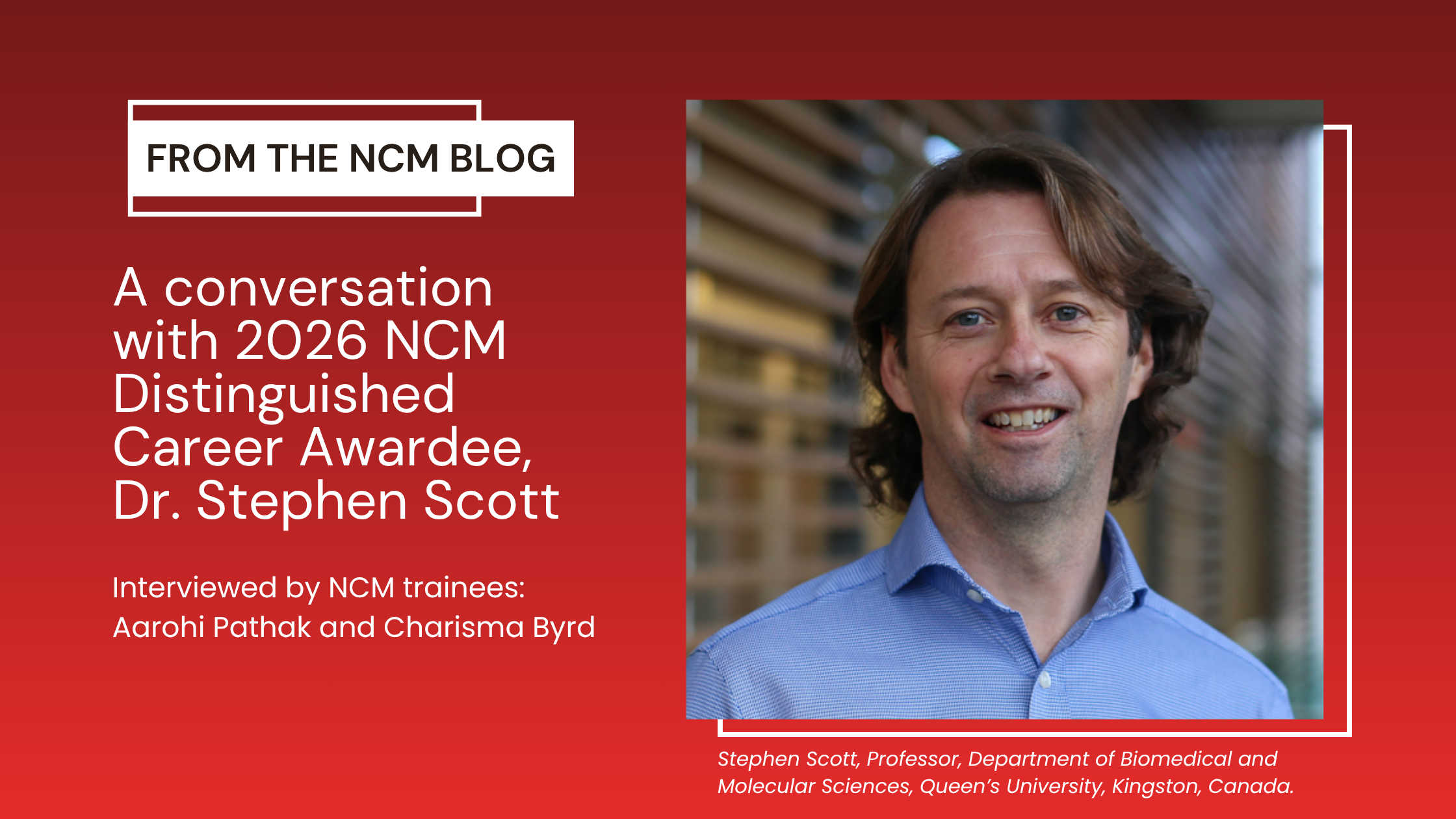
A conversation with 2026 NCM Distinguished Career Awardee, Dr. Stephen Scott
Watch the full interview here.
The 2026 NCM Distinguished Career Award goes to Stephen Scott, Professor in the Department of Biomedical and Molecular Sciences at Queen’s University, Canada. His research focuses on how the brain controls voluntary movement, a question he has approached from multiple angles over more than three decades: muscle mechanics, primate neurophysiology, computational modeling, and the development of the Kinarm, a robotic device he invented to study and assess how the brain controls arm movement. His lab has also trained a large number of researchers now working across the field.
We spoke with him ahead of the 2026 meeting. He is refreshingly honest about how much of it was unplanned.
* * *
Scott’s path into science began at the University of Waterloo, where he was studying systems design engineering and, by his own account, not particularly engaged with it. Running track and cross-country was what held his attention. The turn came from a chance encounter with Dr. David Winter in the kinesiology department, who handed him a dataset on running kinematics and suggested he look at injury patterns. He had no background in biomechanics, went to the library to work through it, and found himself wanting to keep going. He started reading widely across journals, following threads he had never thought to look for, and as he put it, “just got totally hooked.” When asked later what his younger self would be most surprised by, he did not hesitate: “My younger self would be surprised that I was in academia at all.”
From biomechanics he moved into muscle mechanics during his PhD under Jerry Loeb and Fran Richmond at Queen’s University. At the end of it he decided his postdoc would be his last chance to try something completely different, and went to work with John Kalaska recording neurons in monkeys. He had read plenty of papers on it. What he found when he got into the lab was that the papers had not prepared him for how complicated it really was. “When you actually record in the brain,” he said, “it’s oh my god, this is so much more complicated and much more complex than what you get in the papers.”
* * *
He is also candid about the parts of academic life he found genuinely hard. Writing was one. For years his drafts came back from Fran Richmond marked up heavily, revision after revision. He worked through it and is now just as demanding with his own students, because he is convinced that clear communication matters regardless of where a research career goes.
“I actually have a substantial fear of public speaking,” he said, matter of factly. His solution has always been to over-prepare. Early in his career he went into a talk confident and underprepared, and it fell apart. From that point on: “you must prepare enormously, and the more I can prepare, the more I can reduce the fear.” When asked what he wishes every PhD student knew, his answer tied it all together: “To read broadly.”
* * *
His advice to trainees goes beyond the craft of writing and speaking. When it comes to building a career, he starts not with a technique but with a question: where do you want to be in five years? “Get a 5-year plan. Figure out what you want to do in 5 years, and when you’ve solved that, that tells you what you need to do right now.” From there, the rest becomes clearer, including which skills are worth picking up. On computational skills he is direct: the field has changed and “you’re gonna need to pick it up, and that’s not a bad thing.” But he is equally insistent that technique on its own is not enough. Alongside it, he keeps coming back to breadth. “Read widely. Don’t stay in one area.” His own career crossed biomechanics, muscle mechanics, neurophysiology, robotics, and clinical research, not always by design, but each move brought questions and perspectives that the previous field could not have offered. Putting those things together, he said, is where the interesting work tends to come from.
* * *
The interview ended with a lightning round that produced a few memorable answers: most overrated term in neuroscience, “context dependent”; favourite brain area, the primary motor cortex; best conference city, Dubrovnik. And when asked to finish the sentence, the best part of being in the NCM community is, he did not pause:
“All the great colleagues and friends I’ve built up over the years. Period.”
About the Interviewers
Dr. Scott was interviewed by NCM trainees Aarohi Pathak and Charisma Boyd.
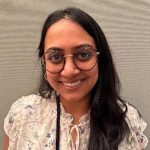
Aarohi Pathak
University of Toronto
Aarohi Pathak is currently pursuing her Ph.D. at the Faculty of Kinesiology & Physical Education, University of Toronto, under the supervision of Professor Timothy Welsh in the Action and Attention Lab. Her doctoral research investigates the mechanisms of interference that emerge when performing two similar tasks in close succession, as well as the contributions of explicit and implicit processes to learning in visuomotor adaptation tasks. Outside of her PhD, Aarohi practices as a registered Occupational Therapist, working with neurodivergent children to help them meet their occupational goals. Her future research aspirations include developing neuroscience-backed rehabilitation training protocols to support sensory processing in children with autism and training protocols to support sensory processing in children with autism and impaired limb use in children with cerebral palsy.
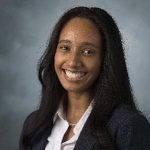
Charisma Byrd
University of Georgia
Charisma Byrd is a PhD student in Biomechanics in the Department of Kinesiology at the University of Georgia, where she conducts research in the Cognition and Dexterity Lab under the supervision of Dr. Jing Xu. Her current work investigates the neuromechanical foundations of hand dexterity, integrating 3D force-sensing technology, quantitative movement analysis, and electromyography signal decomposition methods to characterize skilled hand and finger movements in healthy individuals and people recovering from neurological injury, such as stroke. More broadly, she is interested in how biomechanics and neuromechanics can deepen our understanding of human movement and inform more sensitive approaches to assessment and rehabilitation. Beyond research, Charisma is passionate about mentorship, science communication, and supporting trainee communities.